Showing posts with label Polar Rs800 HRM. Show all posts

Tuesday, February 22, 2011

a bit more technical…

passed the emotional moments...let's dig into the numbers...
(the very few readers of this blog know that I am data-maniac runner)
1) the tapering....
for the first time, I tried to take advantage of the "Training Load" function of the SportTracks3 SW.
Without bothering too much with my own personal data, you can see that the load went down a lot during the last week of January because of work commitment, so I tried to do a bit more in early February to recover, but obviously this involves the risk of getting too tired close to race day…
Chart 2011-02-22
The greenish line (Training Stress Balance) was so still well below “0” very close to the marathon and I really had to take 3-4 days very easy to get a decent taper and reach race day with a TSB of +8.
I think that probably is better to avoid getting so close to a “A” race with tough workout and get more freshness to really have the best performance.
If someone is interested in knowing more about how to use the function, just pop me a message.

2) The carbo-loading:
my terror is always to end up in a part-a-john after 10k because of having eaten too much, and at the same time I still need to eat those 400-500grams extra of carbs to build up reserves for the race
(my friend Stefano knows very well the consequences of this: we ended up with 6 stops in the … while still finishing in 2h34’… he carbo-loaded using cereals…)
So, like I did for Fukuoka, I mainly took some cereal bars, but mostly resorted to carbohydrates in powder. I found a product with acceptable taste and so it was enough to sip all day long. I highly recommend
So my gut was still light and I did not feel too bloated at the start…

3) Race Splits
Distance Time Split time Split pace
5 00:19:28 19:28 03:54
10 00:38:42 19:14 03:51
15 00:57:43 19:01 03:48
20 01:16:37 18:54 03:47
25 01:34:56 18:19 03:40
30 01:53:53 18:57 03:47
35 02:12:16 18:23 03:41
40 02:31:33 19:17 03:51
42,2 02:39:55 08:22 03:49
Difficult to say something on this. The first 10k are uphill, so the pace was fair. From 20 to 35 it is mainly downhill and also we really started to pick up the pace.
The split from 35 to 40 is great, considering the climb out of the tunnel and all the other flyovers, etc…Than I was really done for the day and just keeping the pace.

4) The HR
All the race was done following the indication of the Polar… I did on purpose hold back until the 20Km at the lower end of the MP zone… then it was time to start the race..
Note the spike in bpm around 1h00’…it was right after the fall… It was really an adrenaline boost..!! I had to calm down.. relax back and let the HR goes down again
HR profile SCM 2011

5) The REAL race…
apart from the performance of a middle-age guy… there was a real race going on ahead of meSCMP 21feb2011 SCM 03
Here the article on the local newspaper

SCMP 21feb2011 SCM 02and lastly, the newspaper also find the goodwill to make an article about “the race in the race” for the local runners, where I am also interviewed !!

6) The reward:
for me, the greatest satisfaction is to being able to run in Fukuoka again.. with 2h39' I am sure to make their entry requirements. Now you know where I will spend my first Sunday of December !

Friday, February 18, 2011

Forecasting potential race performance with Polar Running Index

Polar is for me a very mysterious company... they "invented" the HR monitors, their units are packed of very useful functions... but then they do not make any effort to explain how to use in practice the functions made available...
The most mysterious of all is the Polar Running Index, about which I already wrote a couple of times (see HERE and HERE)

Now I try to use the Index as "forward looking tool" to forecast my incoming marathon time....

I own the Polar Rs800 since December 2006 and the trend of the P.R.I. is


Because I wanted to see better how to use Garmin and because the Polar food pod was broken for a while, I miss several data in the most recent period...

Anyway it seems that the past figures give a good idea of how my performance could be.
78-80 : around 2h42' (but that day in Boston the weather was tragic...)
80-82: below 2h40'
85: more around 2h35'

obviously these are my personal data and other people might have different curves.
Also the Index does not keep into consideration the specific training you could have for a specific distance (5000m o Marathon) but only a general indication of aerobic fitness
So I can bet on myself for Sunday that the time probably it can be something around/above 2h40', but then need to be factored by the hilly course and weather conditions (humid...).
I would be very happy to go below 2h42', qualify for Fukuoka and save somehow my legs for the spring marathon

Ok, now all is said and let's see what happens on Sunday

Thursday, August 5, 2010

behind schedule... (and Polar SW Exertion agrees)

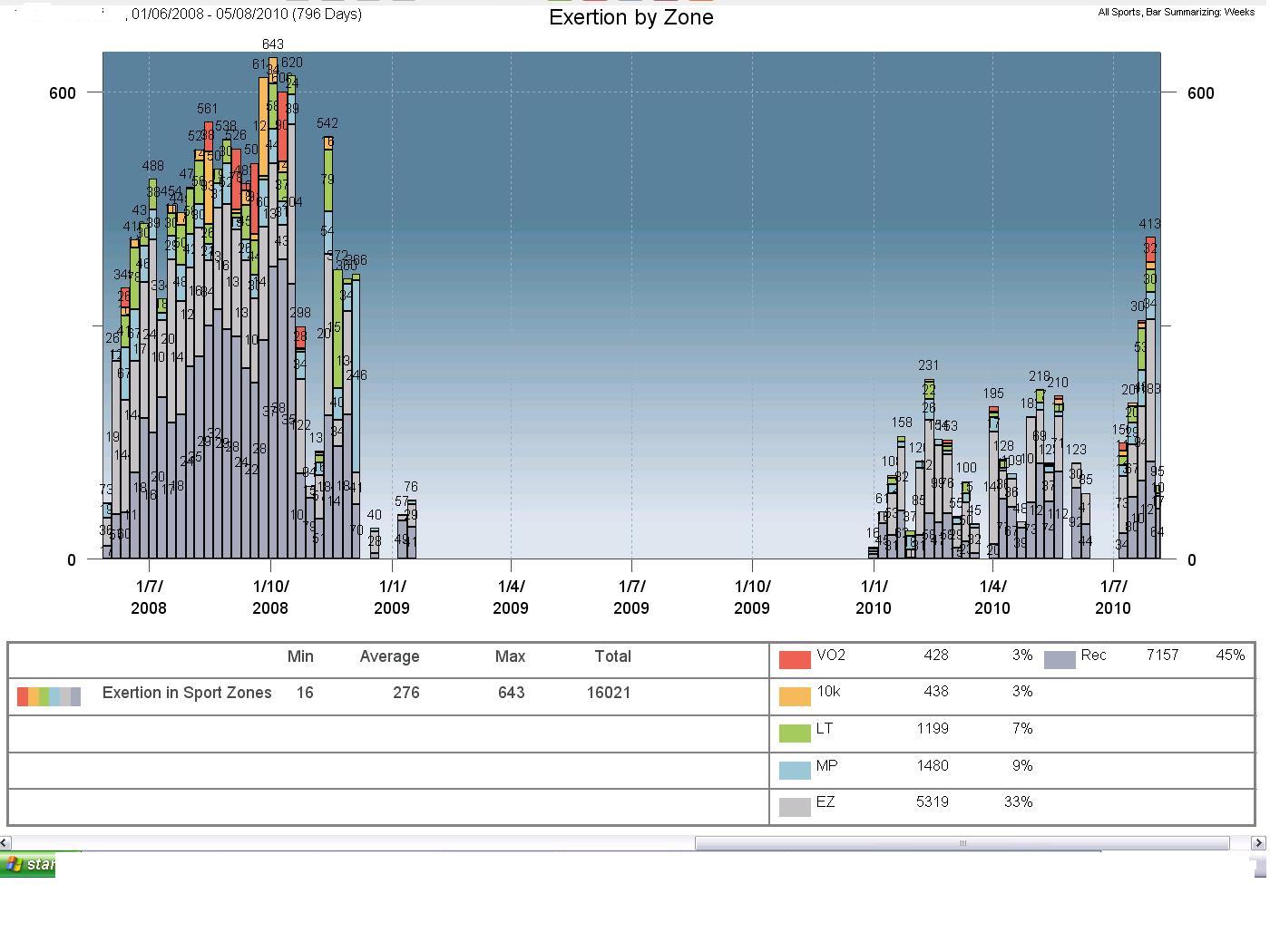
Last night I was browsing my 2008 training  log and I could avoid noticing the huge difference in volume/intensity compared to my recent days.
I really need to crank up my training...

In early August 2008 I was already cranking 100km a week with really big workouts and long runs. Now I am still just jogging around and with only shorter workout....

A good comparison is given using the "Exertion" function in the Polar PT5 SW.
It is probably one of the most useful function of the Polar SW.

at first, it is very important to set-up the function correctly.
There are pre-set parameters, but I think it is worthy to change them.
Personally I followed the "Intensity factor" listed by Jack Daniels in his book at page 39.
I divided my HR training range in bands associated with standard training effort
(Recovery / Easy / Marathon Effort / LT / Vo2 ) and give them a intensity score according to the mentioned page (well, Daniels' table gives point by 1 bpm division, so I took a mid level for each effort band).

In the Polar PPT5 menu, you search for OPTION/ PERSON PROPERTIES / SPORT ZONES / EDIT and set-up the parameters.
Then it becomes a breeze to monitor the training load and also the breakdown of the training into different effort level...
It is much more effective as the pure check of mileage because you have a clear measure of the internal load on the body.

In June 2008, I was doing a consistent 400 points per week and reaching 600 points in August.
Now in 2010 I just barely touched 400 points for a single week...
So huge work ahead...I really need to build up momentum and motivation...


It does not help that the temperature/humidity outside is simply awful...  28C with 85/90% Rh in the early morning and then 34C-35C with 70%Rh on daytime...

From Run back by 7

Monday, May 31, 2010

Garmin 405 vs Polar Rs800 comparison - Round #1

Even being a long time Polar buyer, it is plainly evident that Polar is recently being "outpaced" by Garmin in terms of development for speed/distance monitor...

especially daunting for Polar is the fact that Garmin is both leader in GPS technology and have also acquired the company "Dynastream Innovations" which is the developer of the foot-pod technology used in both Polar and Garmin...
So now Polar relies on Garmin's technology for their stuff... which is not exactly the best strategic positioning..

I found that the real beauty is when you can integrate the data coming from GPS with the accuracy, speed of response and reliability of the foot-pod system.

To make the story short, I will start a series of posts about the comparison between Garmin 405 and Polar Rs800 in terms of "output" for the runner: what to do with all the data coming from the monitors and which of the 2 systems is more "useable" for a serious runner...

I had never ever considered switching to Garmin until I received a 405 as a gift and later discovered the SW Sporttracks, which has an amazing array of plug-ins which are extremely useful....(Garmin has his own SW "Training Center" which is a total crap, while the online log Garmin Connect is nice but mainly for online sharing and not data analysis)
Now the competition is on...

ROUND #1: THE FOOTPOD

I was by chance in a sport shop and I saw the NEW Garmin FoodPod 010-11092-00 on display and I could not sincerely resist because it was beautifully small and I immediately salivated to the idea to have footpod technology couple with GPS data (more of that later...)
Price was 650 HKD which was sensibly cheaper than the RRP in USA (99USD)... so if someone is interested, let me a comment and I will refer the shop.


Yes, the Gamin footpod is MUCH smaller !! The Polar pod is unchanged since 2006 while evidently the folks at Dynastream have worked a lot on a new generation...

WEIGHT:
- Gamin: 7 grams (including battery)
- Polar: 24 grams...

I can also appreciate that Garmin accessories (HR belt, footpod, bike speed reader) all use the same battery model CR2032 (which is very easy to buy), while Polar has 3 different batteries for HR belt, watch and footpod...(did the engineers talk each other during development ??... since the difference between a CR2025 and CR2032 is really negligible...)

Lower weight and smaller profile makes it very easy for the Garmin pod to be tied to the shoes and the plastic clip has a good shape which makes it easy to hold the pod firm to the shoes...

OUT OF THE BOX COMPARISON: Garmin is the sure winner...

CALIBRATION:

My Polar pod was already calibrated, so I went for a calibration of the Garmin's one, which is extremely simple: once the pod is recognized by the wrist unit, I selected the calibration function and you are given the choice to calibrate by a fixed distance (eg: 400m, 1k, etc) or using the GPS.
I went for the GPS system calibration and went for the run... after a while (I suppose it was 1 mile) I got the message that the pod was calibrated with calibration parameter 1008 (factory setting is 1000).
Since it is known that the GPS usually adds up 1% to the real distance.. I then simply manually changed the calibration parameter back to 1000 ...(haha)...

I have not checked yet if the new footpod is so affected by the same pattern of the old Polar, where the calibration was also "speed dependant" (the calibration factor is no more accurate for speeds different from the one used for calibration)

ON-THE-FIELD COMPARISON

I took chance of a run in the forest in Dongguan for a tricky head to head comparison...I looked extremely weird wearing 2 watches and 2 foot-pod at the same time, but so it makes for an effective comparison...

1) the GARMIN GPS did not pick up the signal correctly because of the tree coverage... so the speed reading using GPS was totally out and I did later switch to FootPod speed
(in the Garmin it is possible to choose if the speed/distance reading uses the FootPod or the GPS)
--> Conclusion: another evidence that the GPS alone for training can really suck...

2) it was awfully humid so after 5k I was drenched in sweat and the Garmin 405 crashed...(it is well reported that the bezel gets crazy when wet...). I had to reboot the watch while running...
--> Conclusion: if you buy a Garmin, stay away from the 405 and go for the 310XT which addressed all the problem with the bezel of 405
Result: No contest.... the Polar did his job in proper way... the Garmin crashed

On the next session, I will check more on the "speed drift" phenomenon for both footpod (which is quite troubling if you use the Garmin or Polar for interval training on unmarked road)


Tuesday, March 23, 2010

Polar Running Index (more of)

end of 2008 I did a post on the usage of the Polar Running Index and related chart.
It happens that is the most popular page of this blog, through google searches on the Polar Running Index.
It is a pity that Polar did develop such a useful function and never explained it properly to the users. Even the Polar forum does not offer more...
probably my chart is the only thing publicly available on the practical use of this functions

well, now that chart end up also in a new book by Matt Fitzgerald "The Runner's Edge".
The book makes a pretty good job to explain all the advanced use of Garmin, Polar, etc...how to use the tons of information that are calculated by those toys and train better.
So also the Polar Running Index and the cadence function of the RS800sd got some explanations and useful tips.
I would say a good reading and I must make anyway a couple of remarks
A) the book is totally biased in favour of the TrainingPeaks SW (well, the book's co-author is TrainingPeak's developer), while there is the free alternative of SportTracks and/or simply use the Polar PPT SW
B) maybe (for my tastes) it could have been even more technical and go more into the details (well, I also see that in Amazon's comments someone complained about the opposite... too much technical... well, dude, then you better stick to the Garmin SW to show your friends where have you been running and stop there...)

(disclaimer: I was kindly offered the book by the author as token of appreciation for the small contributions)


Friday, March 27, 2009

Polar oriented training log

I copy/paste a message from a reader. Message which may be useful for other runner who use Polar HRM.
The web-based training log looks interesting.

..........................................
You may be interested to test training calendar I've developed for Polar HRM :
http://polartrainer.free.fr
(my own training: jp75018).
You can create your account or download (open source) from
http://www.php-endurance.org
Note: works only in Metric Units
.........................................

Wednesday, January 21, 2009

Cadence in Running and Performance

the orthopedic told me yesterday that I may need several more weeks of stop (if not months) before resuming running... pretty depressing perspective...

I come up with another chart: how improving the cadence goes down to a benefit in the "bottom line" (racing performance).

So I charted the average cadence of my workouts since I have the Polar Rs800sd, together with the IAAF performance score of my races (across different distance).
(there are many tools over the web to calculate the IAAF points and compare performances on difference distance, eg HERE)
I had to depurate the IAAF scoring my many races held on hilly course or under scorching heat, otherwise it would be a wrong influence on the correlation.

Back in 2006 I soon realized that my cadence (in the low 80s) was far too low compared to what is considered ideal (high 80s, ideally 90). This is really a big contribution given by the Polar Rs800sd and the S3 sensor.
From then, I always worked to improve my 
stride cadence, trying to be light and quick, rather than stomping the feet on the ground. Jack Daniels mentions something like "running on eggs".

The average cadence has gradually gone up (mid 80s), and it matches closely also the trend of the IAAF score. It is a sure call to say that improving the cadence drives an improvement of performance (especially if you current cadence is far from optimal).


Wednesday, December 31, 2008

Running Index vs Cadence

Voila' another chart, exploring if there is a relationship between cadence (leg turnover) and Running Index (hence "effectiveness" in the run).

The graph shows a certain correlation (higher cadence positively related to higher Running Index, calculated automatically by Excel), but I can not swear that it could pass a more accurate statistical study (level of confidence of the correlation, etc), because the variance at each point is in the range of +/-5 (points of RI)...


Polar Running Index in practice

the topic might be interesting only for those using the Polar PPT SW...

I can draw a balance of my 2 years of use of the RS800sd and the related SW.
It is quite interesting to see that the Polar "Running Index" is actually a good predictor of the running shape
The chart maps 2 years of use of the watch and there is a clear relationship between my ups/down, the Running Index and the actual racing performance.
The red thick line is a 20 days moving average, to see better the overall trend rathe
r than the single workouts.
I must anyway remark that obviously also the external temperature has an influence: during the summer periods, the HR is usually higher at equal pace to, so the R.I. becomes unavoidably lower.
For myself, I could draw these references:
- R.I. around 77: means Marathon time around 2h42',
- R.I around 80: Marathon in around 2h38', HM around 1h15'
- R.I. around 84: Marathon likely in 2h33'-34' (that was the prediction based on workouts and 5k race time), HM around 1h13'

I would be very interested to compare data with other runners to see if these values have an "absolute" meaning (eg: 84 means 2h34' for everyone) or specific for each individual


Friday, October 10, 2008

10/October - Running Index

After the "Golden Week" of holidays for the China National Day, back to work for the factory. So I swap the "running camp" to Dongguan...
2 easy run yesterday and today, about 19km each. Weather was warmed up again, but obviously it is not so dreadful like in Summer. So the pace was comfortably around 4'05"-4'15" + some stride.

More interesting is that I extracted again the chart of the Polar Running Index and it looks really awesome.
I can not swear on the validity of the Index, but the correlation between HR and speed during the workouts makes sense as indicator of the general fitness.
Obviously I dot not think that gives any useful indication on the specific endurance/performance for a certain race distance, but at least makes comparable different period of the years or year-on-year.

All said, it is very confortable that my current level is much higher than the run up to my last marathon. It also shows the period of "stale" in September due to "heat fatigue" and mental tiredness.

Wednesday, August 13, 2008

Running Index / Stride Lenght charts @13August

for the "Polar" maniacs...

I extracted these 2 sets of data from the Polar SW and might deserve some remarks..

a) Running Index (the red line is the rolling average of 20 points)
I already showed this chart some months ago with an explanation.
Polar website explanation on the Index here

After 3 solid months of conditioning, the chart is going in the right direction. It is remarkable that I am getting very close to the same levels as my peak form last season, and it is still summer.

Definitely this function of the Polar SW is worthy to keep under watch every month or so to understand the actual trend of the form. There is a quite close correlation between the trend of the Running Index and the actual performances in races.


(Note for Polar PPT users: use the function "report" and later "edit/copy to clipboard". You paste the data to Excel and create this chart)


b) Stride Length Average


This chart leave me rather puzzled...
It seems that in my peak form, the stride got the longest (it makes sense), but I am really perplexed about why it is now declining so considerably in the part 2-3 months, regardless of the remarkable increase of fitness (as shown by the RI above)...
Might be "too much" base training, not enough speedwork, with loss of strength in the legs? I really invite for comments from the readers...

Friday, May 23, 2008

running Index @23May

The Polar RS800sd has an interesting function called "Running Index": basically is kind of indicator of the level of "performance" during a workout, based on the HR and speed.
Higher speed during a run at a lower HR gives you a higher index. It is supposed to mimic a Vo2max level, but I do not take it for granted...
more info on the Polar website.
Anyway in the long term it is a useful indicator of the level of fitness, especially looking at the trend, rather than the actual value of a single workout.
Well, anyway the chart speaks for itself. At the best of my form (January-March) I was around 77-80 for most of the runs. Now I dropped at 70 (at the best), a value similar to the same period of last year.
With index 80, I was running at easy effort at 4'-4'05"/km and the feeling was fantastic. Index 70 is more a kind of struggling already at 4'20" and feeling comfortable at 4'30"...
To restore the right fitness I have anyway a secret weapon ready to be deployed .... (WAIT FOR NEXT POST FOR MORE DETAILS)

Tuesday, January 9, 2007

January 9: my Polar RS800sd

this morning I made a steady run. It was supposed to be over in 40', but the air was fresh, so I went on to 60'. It was probably too much because my ankle started to be in pain again. I got a tendinitis during the Christmas period and missed one week of training. In the past 3 days everything seemed going better but the pain is still there. Probably I run too long.

But today I want to write about the Polar Rs800sd HRM. I bought it 1 month ago because my old Accurex was gone. I did not think it over too much to buy a Polar because I already owned 4 of them and they lasted for years under any weather conditions. Today it seems that also Garmin 205 and Suunto are giving a good run to Polar, but I went for a loyalty purchase.
The Polar rs800 is a fantastic HRM: small, compact, many functions. The SW is really useful because you can plan your workout in absolute details, phase by phase and transfer to the watch easily by IRDA.
BUT ... Jesus ... the food pod S3 is anyway still a hassle . I mean, it is small, very light, but the whole thing requires a calibration process that is never over. Also every time you move the sensor from shoe to shoe, you need to calibrate again ...mmm ... the SW does not manage a calibration factor for a specific pair of shoe, so if you have 2/3 pair of shoes (like most of the serious runners) you must input again the calibration once you change the shoes ...
On top of this, the distance displayed on the watch and the one of the SW are sometimes (often) different. A belgian guy made a very detailed study on the reason of so many bugs and errors in the Polar Sx625 and relative S1 pod, but I sincerely hoped that the new S3 would have solved most of them ... still seems that the weak point of old model are unsolved. I will try to figure out more in the next weeks about how to optimize the calibration, etc and I will keep you updated.
For the time being, I can only say that:
- the systems works ok if you have one single pair of shoes and run at steady pace.
- if you make intervals, or fartlek it is much much better to set the sampling rate at 1s or 5s and start your intervals not from still.

If one day I would meet a technician from Polar, I would have plenty of questions ...
- eg: why if you set up the autolap at 1,0km , the SW and the watch gives you a lap distance of 1,03/1,04km ??!! is there anyway to have autolap at 1,0k and get a lap distance of 1,0km ???